
While the number of dealership buy-sells in the fourth quarter was roughly the same as the 2024 period, the number of dealerships and franchises involved in those deals increased.
Here are five key takeaways — including the top buyers and sellers and top brands and which state recorded the most deals — based on the more than 100 transactions Automotive News tracked so far that closed in the fourth quarter.
Readers with All Access subscriptions can find detailed and researched information on more than 2,000 dealership buy-sell transactions tracked since 2021.
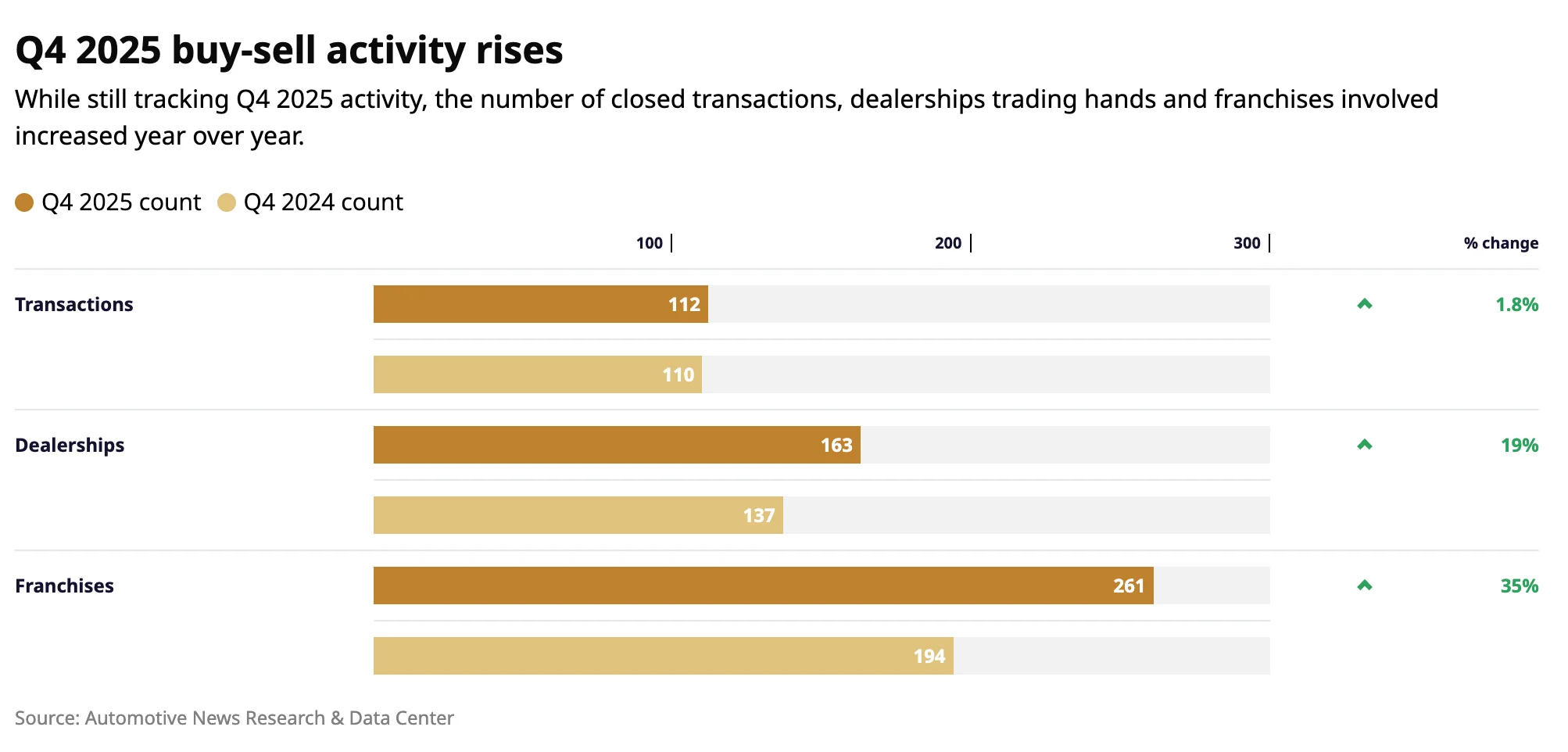
The number of dealership buy-sell deals, stores trading hands and franchises involved in those transactions all increased in the fourth quarter compared with the same quarter in 2024, all as Automotive News continues to track fourth-quarter 2025 deals.
The Automotive News Buy-Sell Database counted 112 fourth-quarter transactions, up slightly from 110 in 2024. In the fourth quarter, Automotive News found 163 dealerships and 261 franchises were involved in the transactions, up from 137 dealerships and 194 franchises in the 2024 fourth quarter.
One reason for the fourth-quarter boost could be the slower start to deals earlier in 2025 amid concerns among dealers around economic policy changes following the 2024 presidential election and during the talk of tariffs leading up to their implementation in the spring, buy-sell insiders say.
Another factor is that dealership buy-sells also are taking longer to complete and to secure approvals from all parties including underwriters, said Willie Beck, co-managing partner of Bel Air Partners, a Tampa, Fla., dealership advisory firm.
Another explanation for the bump? The fourth quarter and particularly December often are busy for buy-sell transactions that aim to close for tax and accounting purposes by the end of a calendar year.
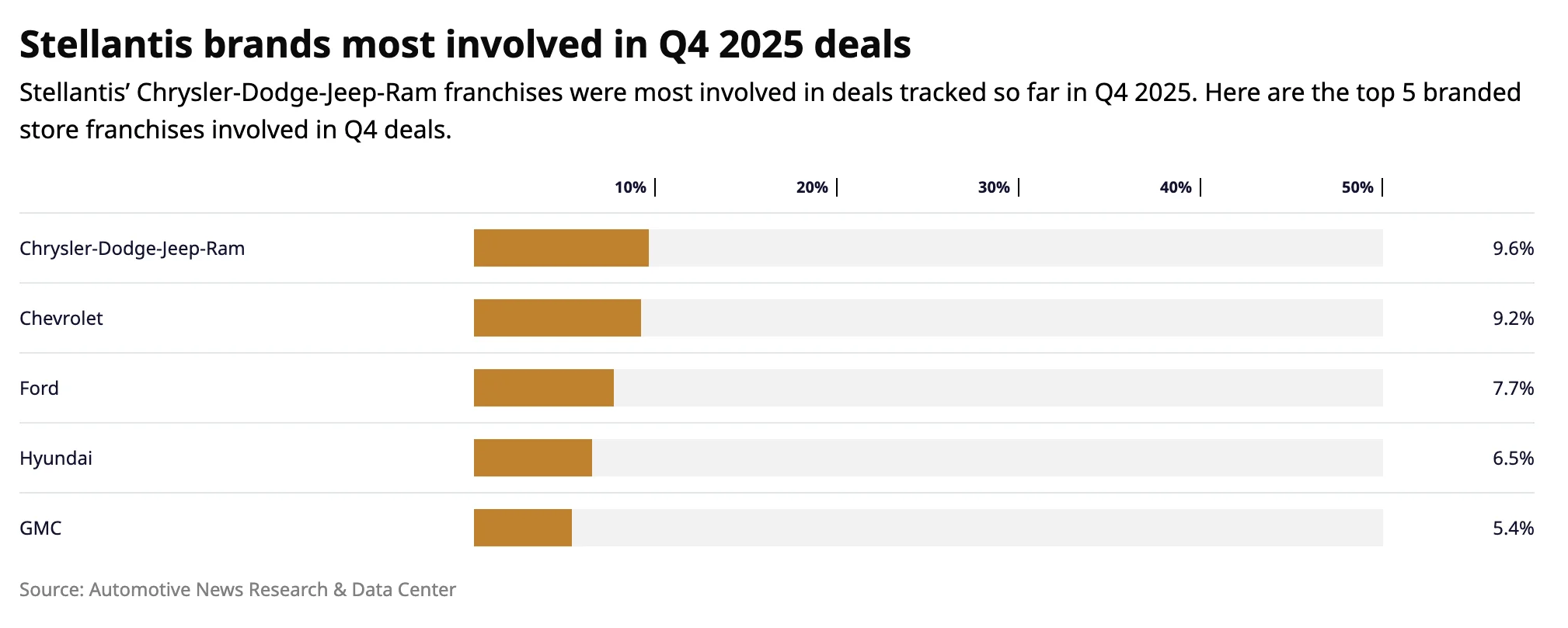
Chrysler, Dodge, Jeep and Ram dealerships were bought and sold the most in the quarter. Automotive News found 25 stores selling these brands traded owners, more than double the number bought and sold in 2024 fourth quarter.
Chrysler-Dodge-Jeep-Ram dealers weren’t giving up on these franchises but were saying, “I can’t fix this, maybe someone else can,” said Alan Haig, president of Fort Lauderdale, Fla., buy-sell firm Haig Partners.
Haig said Stellantis is “still a long way from the glory days of six years ago, but heading in the right direction.” Stellantis new-vehicle sales have declined more than 30 percent since 2020, but “sales have begun to rebound lately as Stellantis is returning to what made it successful in the past: large, high-horsepower vehicles with distinctive design,” Haig said.
John Murphy, managing director of strategic advisory at Haig Partners, said there were mixed feelings among dealers involved in Stellantis dealership transactions in the fourth quarter, with some wanting to be done with the brands.
“Half the people believe there’s an opportunity in the future and you’re probably behind these dealerships at relatively low multiples, so you’re probably going to get pretty good returns over the mid- to long term,” Murphy said.
Coming in second for the most-solddealership brand in the quarter was Chevrolet with 24 stores trading owners, consistent with its 2024 figure
Erin Kerrigan, managing director of Incline Village, Nev., sell-side firm Kerrigan Advisors, said she’s seeing “tremendous demand” for Chevrolet stores.
“General Motors is well positioned to benefit from the Trump administration’s policies which favor domestically manufactured vehicles,” Kerrigan said. “Also, the company took the smallest write-off of the domestic OEMs related to its EV investment and appears to be best positioned to transition production back to ICE and hybrid vehicles."
Ford was third with 20 stores sold, followed by Hyundai at 17, up from eight the same quarter a year earlier.
“We see more dealers deciding to sell their Hyundai stores rather than invest in the expensive facilities that are required to be image compliant,” Kerrigan said. “On the flip-side, we continue to see demand for Hyundai franchises given the strength of Hyundai’s sales momentum.”
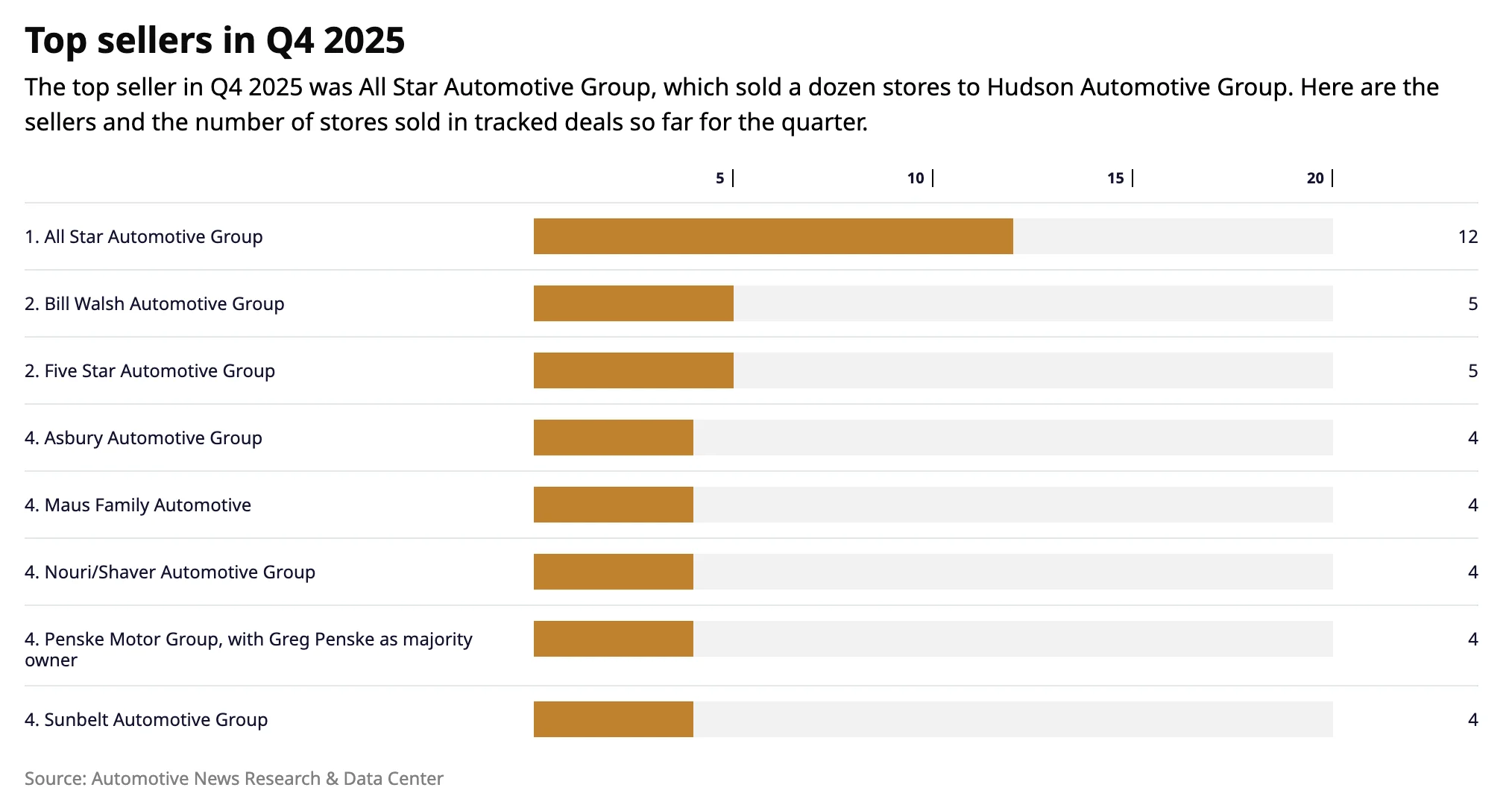
Hudson Automotive Group in the fourth quarter bought more dealerships than any other. The retailer purchased 12 stores from All Star Automotive Group, owned by Matt McKay. The Charleston, S.C., group acquired dealerships in the Baton Rouge, La., area.
All Star Automotive sold the most stores in the quarter.
Lithia Motors Inc. was the second-most acquisitive in the quarter. The publicly held auto retailer bought six stores. Five of the dealerships were in California, and one was a Subaru store in Georgia. Lithia CEO Bryan DeBoer said in an Oct. 22 third-quarter earnings call that he was “pretty excited” about the retailer’s fourth-quarter acquisitions and Lithia was able to “find them in this type of market, especially the quality of the deals.”
Coming in with the third-largest number of dealership purchases in the fourth quarter, each buying five stores, were: ALM Automotive Group of Norcross, Ga.; Go Auto of Edmonton, Alberta; and Jim Bozich and Mark Geiger, owners of Home Run Auto Group of Janesville, Wis.
Tied as the second-biggest sellers in the quarter were Bill Walsh Jr., owner of Bill Walsh Automotive Group, and Five Star Automotive Group. Walsh on Dec. 15 sold all five of his Ottawa, Ill., stores to Home Run Auto. And Five Star Automotive that same month sold five suburban Atlanta stores to ALM Automotive Group.

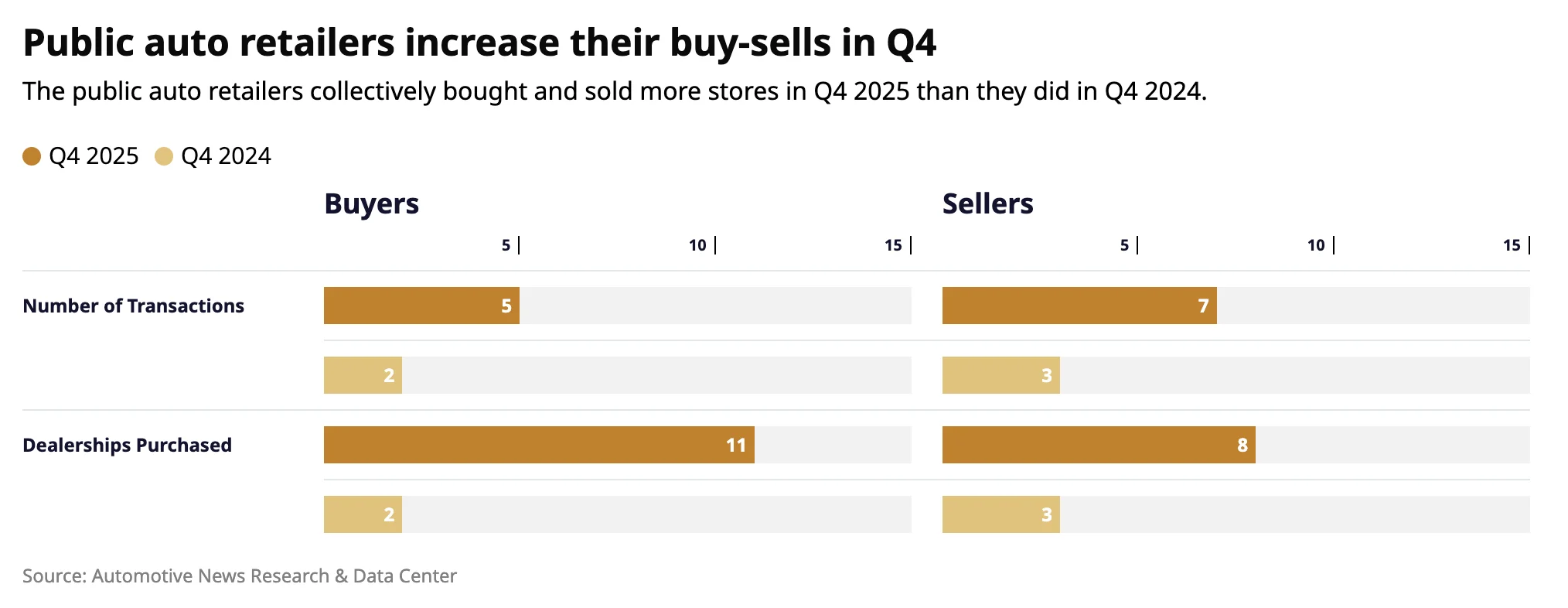
The six publicly traded dealership groups were buyers in five deals in the final quarter last year, up from two deals at the end of 2024.
Collectively, the publics bought 11 stores in the quarter compared with two in the same quarter a year earlier.
Lithia was the buyer in three of those deals, with Penske Automotive Group Inc. and AutoNation Inc. also acquiring.
The public companies also were sellers in seven deals, an increase of four deals year over year. Together, the publics sold eight stores compared with three dealerships they divested in the same 2024 quarter.
Asbury Automotive Group Inc. was the seller in three of the fourth-quarter 2025 deals, divesting of stores in three states. Group 1 Automotive Inc., Lithia and Penske Automotive also were sellers in the quarter.
The public dealership groups had to sell off some stores following large acquisitions, said Bill Scrivner, CEO of Pinnacle Mergers & Acquisitions, a buy-sell firm in Southlake, Texas.
That is “both due to agreements with manufacturers in order to get big deals approved,” he said. And they “sell off underperforming stores to get individual stores approved.”
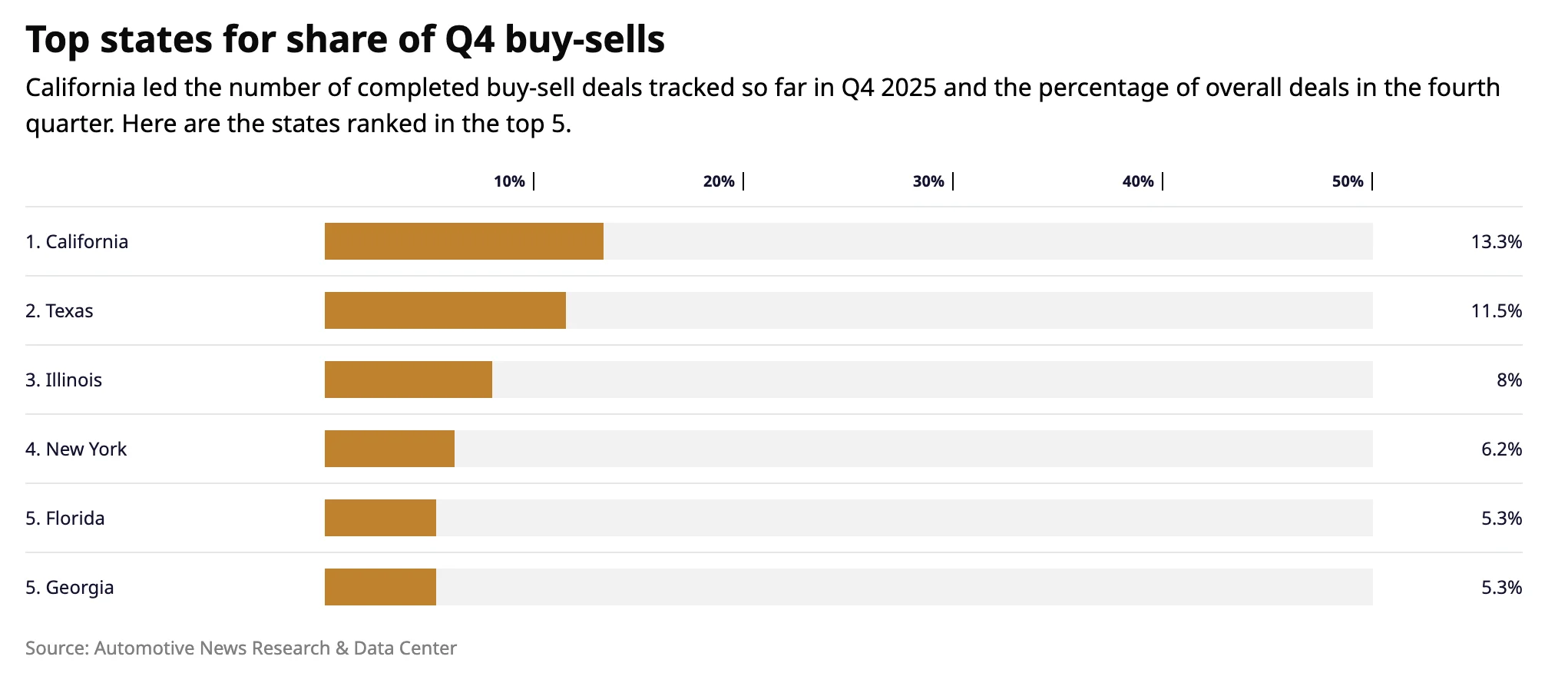
Twenty four dealerships changed hands in California during the last three months of 2025 , an increase of 18 from the fourth quarter of 2024.
Those deals included Hansel Auto Group buying a Ford store and Pedder Auto Group buying a Hyundai dealership in Moreno Valley.
Texas, Georgia, Illinois and Louisiana followed with the most dealerships sold per state.
California dealerships often have higher-than-average sales and throughput, said Brian Maas, president of the California New Car Dealers Association. But the state also has stricter labor laws and dealership regulations, which can make operating a store in the state more challenging, he said.
Maas has seen more interest in buyers being from larger dealership groups that can better handle regulatory complexity, he said. The most popular brands are Toyota, Honda and luxury stores, Maas and Scrivner said.
When President Donald Trump’s administration in June eliminated California’s authority to write its own vehicle emissions standards, it removed a significant layer of uncertainty for dealers there and in other states that had signed on to follow California’s standards, Haig said at his group’s Maximizing Value Conference at the NADA Show.
In the wake of that reversal, major private and public retailers began investing in California and deals that were struggling saw renewed interest and stronger offers, Haig said.
Looking into 2026, the California governor’s election could create some uncertainty in the buy-sell market, Maas said.
“But overall, I don’t see that changing the baseline numbers very much,” Maas said. “California continues to be a robust car market.”
Kerrigan Advisors is the leading sell-side advisor and thought partner to auto dealers nationwide. Since its founding in 2014, the firm has led the industry with the sale of over 450 franchises generating more than $11 billion in client proceeds, including three of the largest transactions in auto retail history – the sale of Jim Koons Automotive Companies to Asbury Automotive Group, Leith Automotive to Holman, and Hennessy Automotive Companies to Group 1 Automotive (planned and expected to close in Q4 2026). The firm advises the industry’s leading dealership groups, enhancing value through the lifecycle of growing, operating and, when the time is right, selling their businesses. Led by a team of veteran industry experts with backgrounds in investment banking, private equity, accounting, finance and real estate, Kerrigan Advisors is the only firm in auto retail exclusively dedicated to sell-side advisory, providing its clients with the assurance of a conflict-free approach.
Kerrigan Advisors monitors conditions in the buy/sell market and publishes an in-depth analysis each quarter in The Blue Sky Report®, which includes Kerrigan Advisors’ signature blue sky charts, multiples and analysis for each franchise in the luxury and non-luxury segments. To download a preview of the report, click here. The firm also releases monthly The Kerrigan Index™ composed of the seven publicly traded auto retail companies with operations focused on the US market. The Kerrigan Auto Retail Index is designed to track dealership valuation trends, while also providing key insights into factors influencing auto retail. To read the 2025 Kerrigan Dealer Survey, click here. To read the 2026 Kerrigan OEM Survey, click here. Kerrigan Advisors is also the co-author of NADA’s Guide to Buying and Selling a Dealership. Additionally, Kerrigan Advisors publishes a podcast, Beyond Blue Sky – A Kerrigan Conversation, where Kerrigan Advisors’ clients and industry leaders share the mindset, strategy and personal stories behind a once-in-a-generation transaction.
Contact us to learn more about Kerrigan Advisors’ sell-side services.
All of our conversations are 100% confidential.


