
Online used-car company presents a radical plan for its stores.
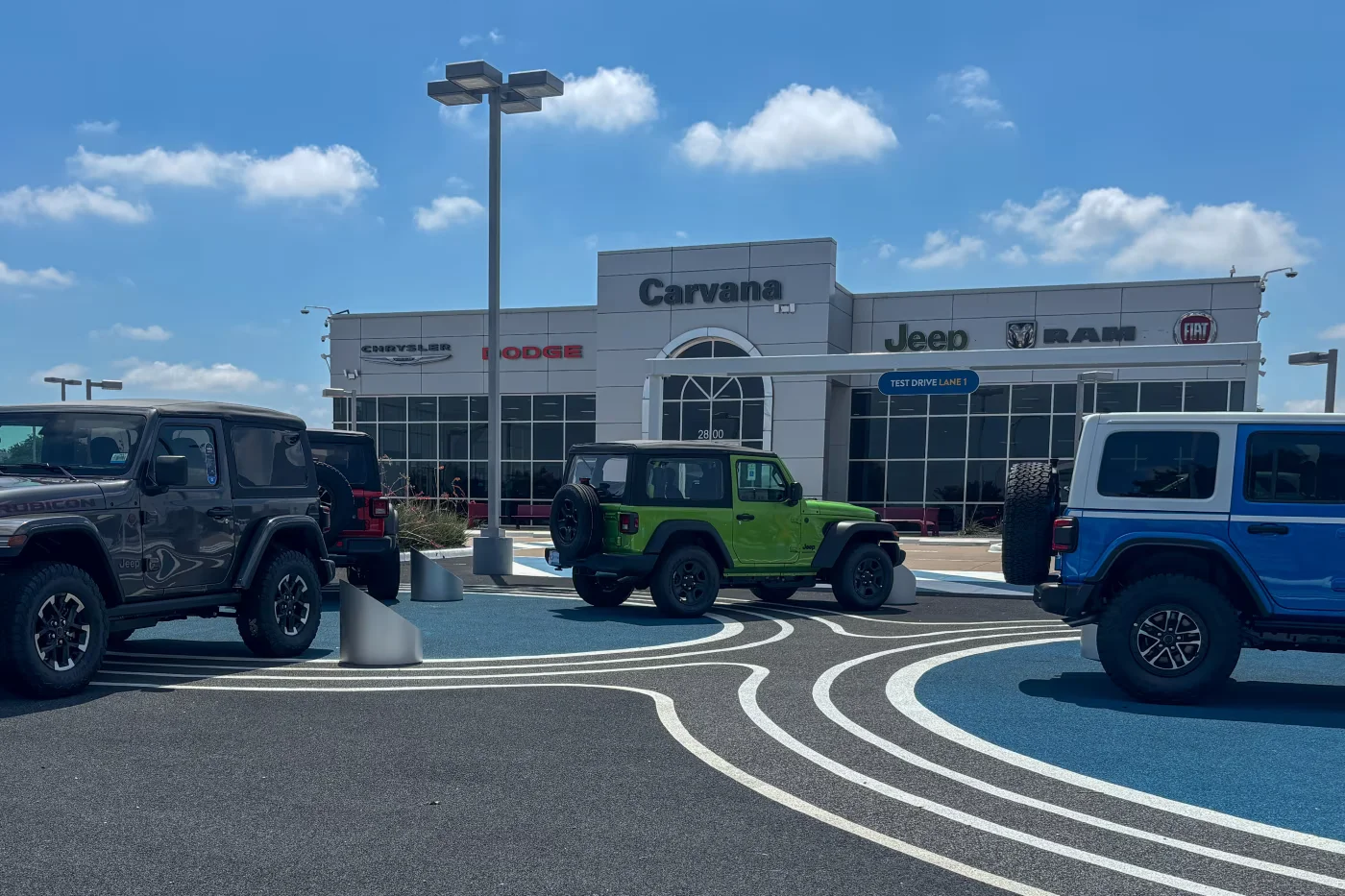
DALLAS—Carvana CVNA -7.54% 🔻 became famous for its giant “vending machines” that house the used cars it sells online. Now, as the chain branches into new-car sales, it is trying a different approach: “new-car playgrounds.”
The Tempe, Ariz.-based company this week revealed its concept for a new-car dealership designed for smartphone-based shopping rather than paperwork and interactions with salespeople.
At the playground, customers can sit inside vehicles and use their phones to get details or order a test-drive, with or without the involvement of a store employee.
“We’re not trying to sell cars here,” Tom Taira, Carvana’s president of special projects, told reporters at its recently remodeled Chrysler-Dodge-Jeep-Ram store in Dallas. “We’re trying to present cars.”
The store is one of seven new-car dealerships that Carvana has amassed after a buying spree that began in February 2025. All of them sell vehicles from the automaker Stellantis. There is potential for Carvana to buy more Stellantis stores, Taira said. He declined to comment on whether the company was interested in selling new cars from other automakers.
For now, new cars remain a small part of Carvana’s business, representing about 2,200 of its 67,000 cars for sale as of Tuesday, according to the company. “At this stage, we do continue to think of this as a test,” Taira said.
Carvana is entering controversial territory by selling new cars—a market long reserved for traditional dealerships and protected by state laws. By offering online ordering, no-haggle pricing and interstate delivery for new vehicles, Carvana has disrupted the status quo, drawing curiosity and anxiety from old-school dealers fearing for their business model.
While almost anything goes in selling used cars, manufacturers such as Stellantis require new-car dealers to maintain retail spaces to precise standards. An eight-story “vending machine” to store cars ordered online wasn’t going to cut it.
Carvana’s initial answer is now on display at the Dallas dealership it purchased about nine months ago.
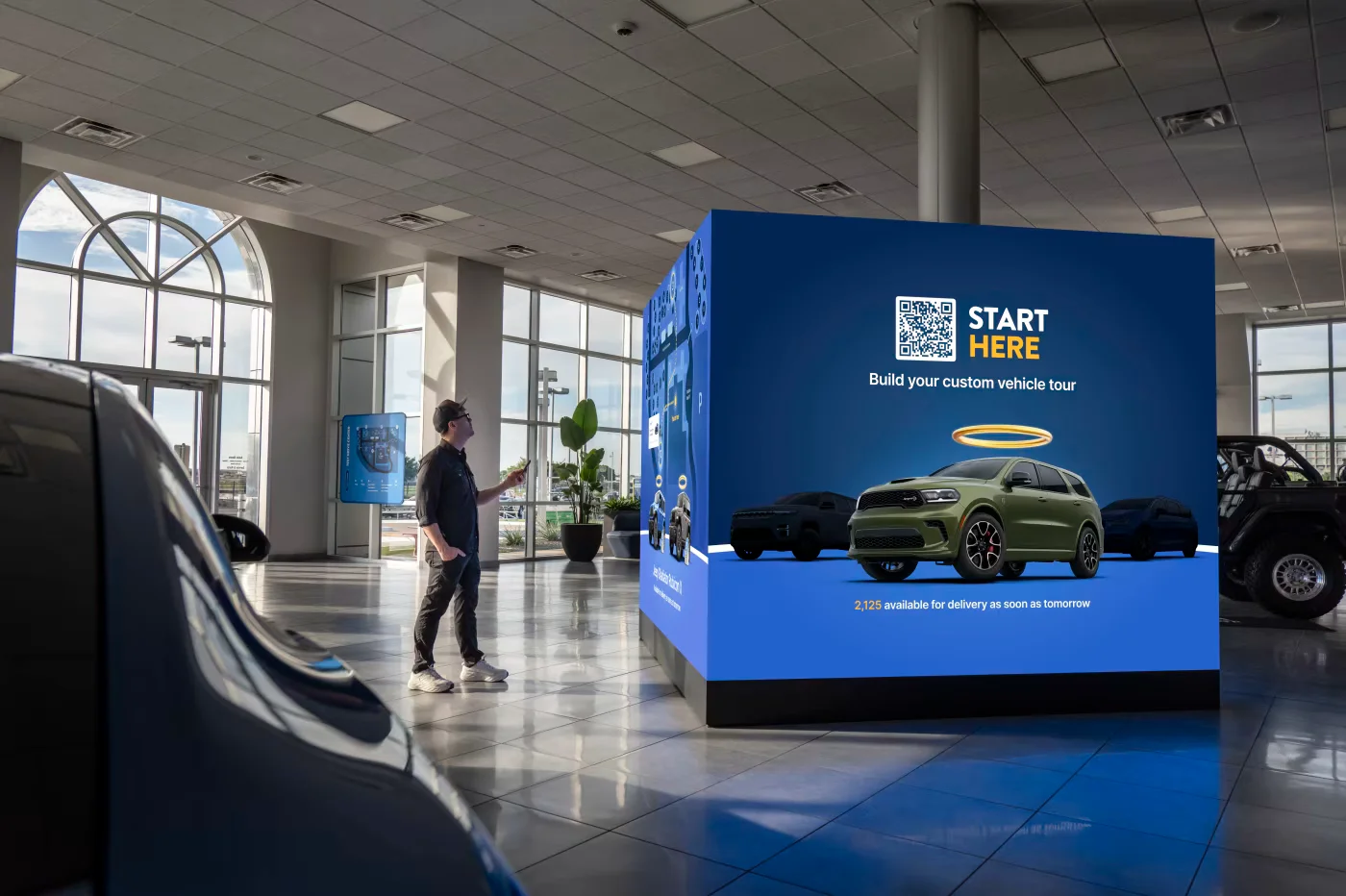
In the lobby, customers stand before a giant cube with four 10-foot by 10-foot screens. After taking control using their smartphones, they can use a screen to select the vehicles they are considering. Afterward, they are directed to the “playground” outside, where they can see their choices in person.
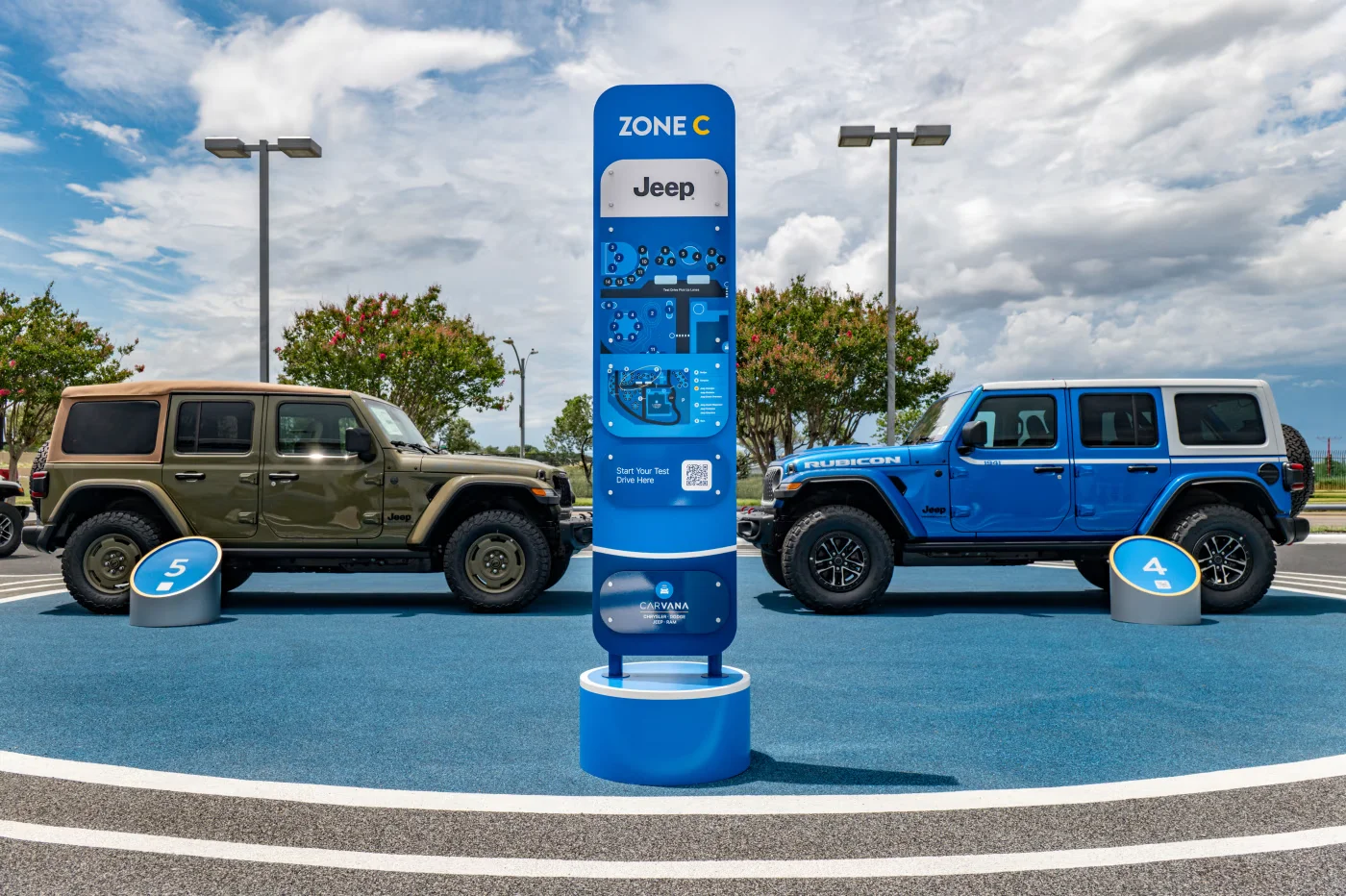
Neatly arranged vehicles sit atop rubber playground turf, sometimes with themes to match, such as a soccer goal next to the Chrysler minivans and a faux racetrack for the Dodge muscle cars.
“Kind of like Disneyland,” said Paul Keister, Carvana’s chief creative officer.
Test-drives can be ordered by scanning QR codes. Cubicles, where salespeople used to “talk numbers” and finance managers attempted to persuade customers to add extended warranties, have been repurposed. One has living-room furniture, and another has a small table for toddlers and a toy train.

Sales advocates are available, and they don’t work on commission, unlike at most regular dealers. They are primarily around to answer questions about the vehicles and walk customers through the sale on the customers’ own phones or computers. Carvana sets a single, nationwide price for each vehicle—no wiggle room.
Carvana might pattern its six other new-car stores after the Dallas location, but any growth depends on its reception with buyers, Taira said.
The innovative part of Carvana’s model is that it uses fewer people, said Erin Kerrigan, who runs a dealership-advisory firm. That means, she said, the company’s payroll per location is likely much less than at traditional dealers, which dedicate roughly half their expenses to employee wages and commissions.
“This is a totally different approach,” she said.
Taira declined to say how many sales advocates Carvana employs at each store.
After stoking bankruptcy concern in 2022, Carvana has surged to a market cap of around $76 billion after restructuring its debt and achieving profitability. It sold nearly 600,000 used cars last year, 43% more than in 2024.
The company’s stock is almost 100 times its record closing low in December 2022.
Carvana’s foray into new cars creates some hiccups for the industry, Mike Stanton, president of the National Automobile Dealers Association, said Tuesday at a conference in Detroit.
Its ability to sell a car online and deliver it hundreds or even thousands of miles away scrambles a system in which manufacturers judge dealers based on sales in geographic areas, Stanton said.
At the same time, Carvana’s moves show that most people don’t want to buy a new car entirely online, Stanton said.
“They want to go into the store and test that product out and talk to a real human being,” he said. “I see it as more they’re coming our way, and we also need to do a better job in the digital space.”
Kerrigan Advisors is the leading sell-side advisor and thought partner to auto dealers nationwide. Since its founding in 2014, the firm has led the industry with the sale of over 450 franchises generating more than $11 billion in client proceeds, including three of the largest transactions in auto retail history – the sale of Jim Koons Automotive Companies to Asbury Automotive Group, Leith Automotive to Holman, and Hennessy Automotive Companies to Group 1 Automotive (planned and expected to close in Q4 2026). The firm advises the industry’s leading dealership groups, enhancing value through the lifecycle of growing, operating and, when the time is right, selling their businesses. Led by a team of veteran industry experts with backgrounds in investment banking, private equity, accounting, finance and real estate, Kerrigan Advisors is the only firm in auto retail exclusively dedicated to sell-side advisory, providing its clients with the assurance of a conflict-free approach.
Kerrigan Advisors monitors conditions in the buy/sell market and publishes an in-depth analysis each quarter in The Blue Sky Report®, which includes Kerrigan Advisors’ signature blue sky charts, multiples and analysis for each franchise in the luxury and non-luxury segments. To download a preview of the report, click here. The firm also releases monthly The Kerrigan Index™ composed of the seven publicly traded auto retail companies with operations focused on the US market. The Kerrigan Auto Retail Index is designed to track dealership valuation trends, while also providing key insights into factors influencing auto retail. To read the 2025 Kerrigan Dealer Survey, click here. To read the 2026 Kerrigan OEM Survey, click here. Kerrigan Advisors is also the co-author of NADA’s Guide to Buying and Selling a Dealership. Additionally, Kerrigan Advisors publishes a podcast, Beyond Blue Sky – A Kerrigan Conversation, where Kerrigan Advisors’ clients and industry leaders share the mindset, strategy and personal stories behind a once-in-a-generation transaction.
Contact us to learn more about Kerrigan Advisors’ sell-side services.
All of our conversations are 100% confidential.


