Dealership consolidation hit a record 462 buy-sell deals in the year to mid-2026, even as profits cooled. Here is why buyers keep betting on scale.
Key Takeaways:
The car business rarely makes front pages for its plumbing, but one of its most important shifts is happening at the ownership level. Dealership consolidation is running at a record pace, with large groups snapping up family-owned stores faster than at almost any point on record. The dealership on your local high street increasingly belongs to a company that owns dozens, or hundreds, more.
What makes this striking is the timing. Dealers are buying aggressively even though profits have cooled from their pandemic peaks. That tells you something about where the industry thinks the money will be: not in a single good year, but in the long game of scale.
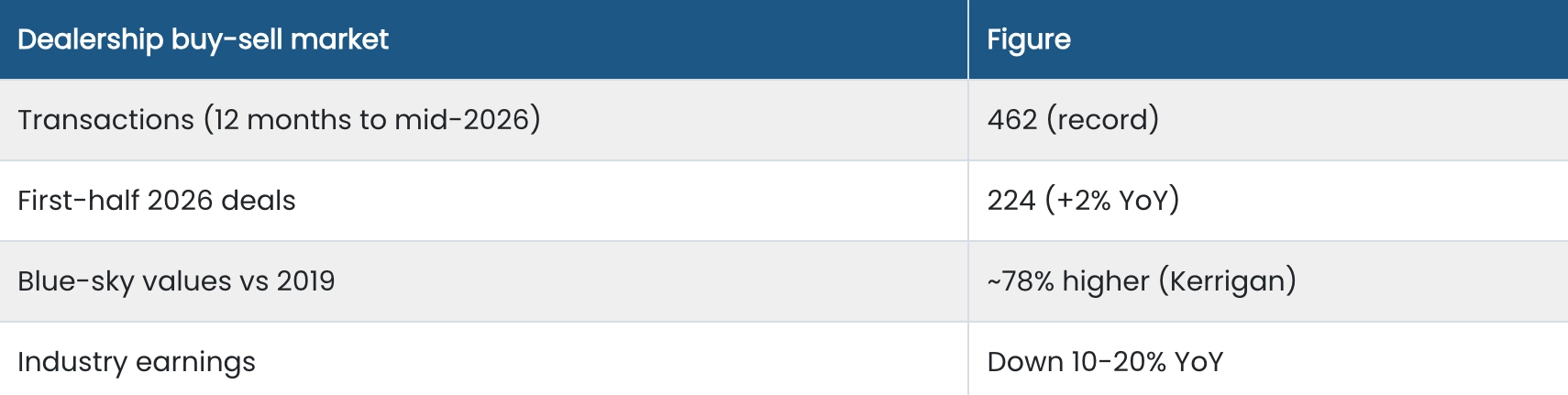
The numbers come from Kerrigan Advisors, which tracks the buy-sell market. Dealers completed a record 462 transactions in the trailing twelve months through the middle of 2026, edging past the prior year’s high. In the first half of 2026 alone, 224 dealerships changed hands, up about 2% on the same period a year earlier, and those 462 trailing-year deals spanned a record 724 franchises as buyers chased scale.
In plain terms, dealerships are changing hands at a far faster clip than before 2020, and the pace is not slowing. Each of those transactions represents a family or small group deciding to sell, and a larger buyer deciding that owning more stores is worth the price.
If earnings are falling, why is dealership consolidation accelerating? Because scale changes the economics of a car dealer. A group that owns many stores can spread back-office costs, negotiate harder with lenders and vendors, share inventory across locations, and build the kind of digital retailing that a single store cannot afford on its own. The bigger the group, the lower the cost of running each dealership.
There is also a defensive logic. As new-car pricing power fades from its pandemic highs, dealers are leaning harder on the parts of the business that hold up better, service and repairs, and the finance and insurance sold alongside each car. Those steadier profit streams reward operators with volume, which is exactly what consolidation delivers.
Technology sharpens the case further. Customers increasingly research, finance and even buy online, and a convincing omnichannel experience costs real money to build and maintain. A large group can develop that once and roll it out across every store, while a single dealer struggles to justify the spend. Each wave of dealership consolidation therefore tends to feed the next, as scale lowers costs, higher profits fund more acquisitions, and the groups that move early pull further ahead of the rest.
Dealers are not buying for this year’s profit. They are buying for the cost advantages that only scale can unlock, and betting those outlast the cycle.
Public groups and big operators lead the charge
The most active buyers are large private groups and the publicly listed retailers, who have the balance sheets to keep acquiring through a softer patch. The listed groups alone poured about $2.6bn into acquisitions in the first half of 2026, with their average blue-sky outlay per dealership reaching roughly $119m. They tend to add stores where they can gain scale, favouring high-volume dealerships and strong local-market brands. Multi-store deals, where several franchises change hands at once, have become a defining feature of the market rather than the exception.
That concentration of ownership mirrors a pattern we have traced elsewhere in the car business, from software-defined vehicles becoming a new profit engine to the shifting economics of car ownership. The common thread is that value is migrating toward whoever controls scale and data.

Why so many owners are selling
Consolidation needs sellers as well as buyers, and the supply of stores for sale is unusually deep. Many dealerships are still owned by founders who built them decades ago and are now reaching retirement without an obvious successor. Cashing out at today’s elevated valuations, while a well-funded group is eager to buy, is an attractive exit. For a single-store owner, the timing may never look better.
The job has also grown harder. Running a modern dealership now means investing in electric-vehicle servicing, online retailing, software and data systems, and tighter compliance, all at once. Those are expensive capabilities for a lone operator to build and easy ones for a large group to spread across many sites. That gap in what each can afford is a quiet engine of dealership consolidation, pushing smaller owners toward a sale rather than a costly catch-up.
Prices reflect the demand. The intangible value of a franchise, known in the trade as blue-sky, has stayed firm for the strongest brands even as profits dipped, sitting roughly 78% above 2019 levels, because buyers are pricing in years of future scale rather than a single year’s results. Top franchises in good markets still command a premium, which keeps tempting owners to sell into the wave of dealership consolidation.
For carmakers, a more consolidated retail base is a mixed blessing. Large, well-run groups can deliver a slicker, more consistent customer experience and invest in the technology modern buyers expect. But they also negotiate harder and concentrate power in fewer hands, which shifts the balance between manufacturer and retailer. The days of the single-store family dealer as the industry’s backbone are fading.
For buyers, the effect is subtle but real. A professionally run group can mean smoother service and better digital tools, yet less of the local, owner-led character that defined car buying for generations. The trust that a dealership earns, much like the protection explored in the warranty economy, becomes a brand asset managed at group level rather than by a familiar face on the forecourt.
None of this is slowing down. With scale advantages on offer and plenty of ageing owners ready to sell, dealership consolidation looks set to keep running hot into 2027. The question is no longer whether the market consolidates, but how large the biggest groups will become, and what that means for everyone who buys a car. For the underlying data, Kerrigan Advisors publishes the quarterly figures, Automotive News tracks the retail beat, and you can follow the sector through our auto coverage and our guide to the best electric cars.
Editor’s Note: When buyers keep paying premiums in a down year, they are telling you where they think the durable advantage sits. In car retail right now, that answer is scale.
Kerrigan Advisors is the leading sell-side advisor and thought partner to auto dealers nationwide. Since its founding in 2014, the firm has led the industry with the sale of over 450 franchises generating more than $11 billion in client proceeds, including three of the largest transactions in auto retail history – the sale of Jim Koons Automotive Companies to Asbury Automotive Group, Leith Automotive to Holman, and Hennessy Automotive Companies to Group 1 Automotive. The firm advises the industry’s leading dealership groups, enhancing value through the lifecycle of growing, operating and, when the time is right, selling their businesses. Led by a team of veteran industry experts with backgrounds in investment banking, private equity, accounting, finance and real estate, Kerrigan Advisors is the only firm in auto retail exclusively dedicated to sell-side advisory, providing its clients with the assurance of a conflict-free approach.
Kerrigan Advisors monitors conditions in the buy/sell market and publishes an in-depth analysis each quarter in The Blue Sky Report®, which includes Kerrigan Advisors’ signature blue sky charts, multiples and analysis for each franchise in the luxury and non-luxury segments. To download a preview of the report, click here. The firm also releases monthly The Kerrigan Index™ composed of the seven publicly traded auto retail companies with operations focused on the US market. The Kerrigan Auto Retail Index is designed to track dealership valuation trends, while also providing key insights into factors influencing auto retail. To read the 2025 Kerrigan Dealer Survey, click here. To read the 2026 Kerrigan OEM Survey, click here. Kerrigan Advisors is also the co-author of NADA’s Guide to Buying and Selling a Dealership. Additionally, Kerrigan Advisors publishes a podcast, Beyond Blue Sky – A Kerrigan Conversation, where Kerrigan Advisors’ clients and industry leaders share the mindset, strategy and personal stories behind a once-in-a-generation transaction.
Contact us to learn more about Kerrigan Advisors’ sell-side services.
All of our conversations are 100% confidential.